

[ad_1]
Iranians headed to the polls on Friday for a snap election following the sudden death of President Ebrahim Raisi in a helicopter crash last month.
Analysts described the election as a three-way contest. The hard-line candidates include former nuclear negotiator Saeed Jalili and parliamentary speaker Mohammad Bagher Qalibaf, with Shiite cleric Mostafa Pourmohammadi also in the race despite poor polling. The reformist candidate, Masoud Pezeshkian, seeks a return to the 2015 nuclear deal and improved relations with the West.
A high voter turnout could favor Pezeshkian, a 69-year-old heart surgeon who has aligned himself with figures like former President Hassan Rouhani. However, it remains uncertain if Pezeshkian can muster enough support to energize the electorate. As has been the tradition since the 1979 Islamic Revolution, women and advocates for radical change are excluded from the ballot, and the election lacks oversight from internationally recognized monitors.
Iran’s 85-year-old Supreme Leader Ayatollah Ali Khamenei has issued a veiled warning to Pezeshkian and his supporters about their pro-American stance.
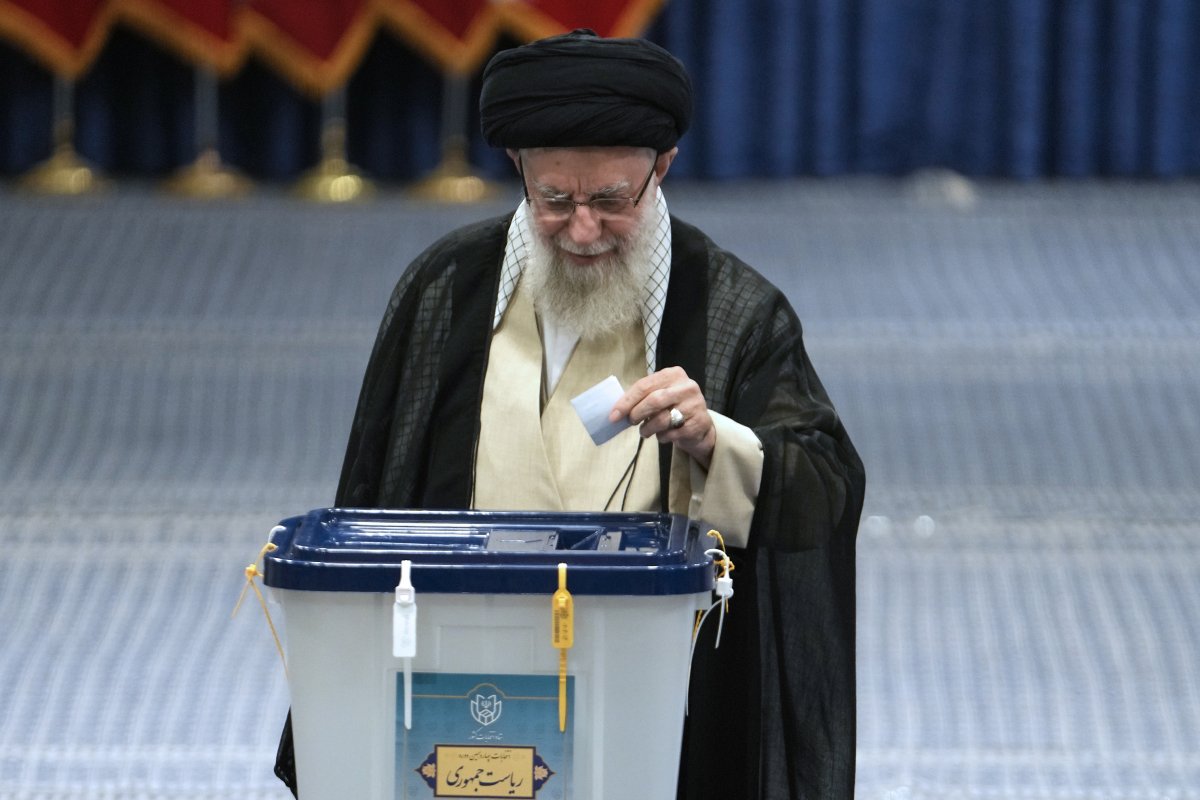
AP Photo/Vahid Salemi
Despite the importance of the election, voter turnout remains uncertain due to record-low participation in recent elections. Years of economic hardship, mass protests, and regional tensions have eroded public confidence in the Islamic Republic. Khamenei was one of the first to cast his vote on Friday, urging citizens to participate. “People’s turnout with enthusiasm, and higher number of voters—this is a definite need for the Islamic Republic, [sic]” he stated.
Abbas Milani, a director of Iranian studies at Stanford University, told Newsweek. “People must participate in the elections to help preserve [Khamenei’s] regime. He has all but lost hope in garnering participation in big cities and is begging for villages to take part. The policies that will be followed are the ones followed by the now descended Mr. Raisi, particularly continued animosity toward the US. In short, people must participate in the election so that he can more forcefully follow his failed policies.”

RAHEB HOMAVANDI/AFP via Getty Images
The election comes at a time of heightened tensions in the Middle East, exacerbated by the ongoing Israel-Hamas war in Gaza. In April, Iran made its first-ever direct military strike on Israel in response to the conflict, while Iranian-backed militias, including Lebanon’s Hezbollah and Yemen’s Houthi rebels, have intensified their attacks.
Simultaneously, Iran continues to enrich uranium to near weapons-grade levels, maintaining a stockpile sufficient to produce multiple nuclear weapons if it chooses.
Iranian law requires a candidate to secure more than 50% of votes to win. If no candidate achieves this, the top two will face a runoff.
President Raisi, who died on May 19, was a close ally of Khamenei and a potential successor. Known for his involvement in the 1988 mass executions and the brutal crackdown on protests following Mahsa Amini‘s death in 2022.
Uncommon Knowledge
Newsweek is committed to challenging conventional wisdom and finding connections in the search for common ground.
Newsweek is committed to challenging conventional wisdom and finding connections in the search for common ground.
[ad_2]
Source link