

[ad_1]
Incumbent Nicolás Maduro has been declared the winner of Venezuela’s presidential election by the government-controlled electoral authority, after a campaign marred by intimidation and other irregularities. The opposition has disputed his victory, while the U.S. has expressed “serious concerns” about the election’s results.
Venezuela’s National Electoral Council (CNE) announced just after midnight on Monday, with 80 percent of ballots counted, that Maduro had won with 51.2 percent of the vote. The opposition candidate, Edmundo Gonzáles, had received 44.2 percent.
Gonzáles was put forward for the presidency after the government banned opposition leader María Corina Machado from holding office for 15 years following her victory at the opposition’s independently run presidential primary in October 2023. The government’s decision was upheld by Venezuela’s Supreme Justice Tribunal in January.

JUAN BARRETO/AFP via Getty Images
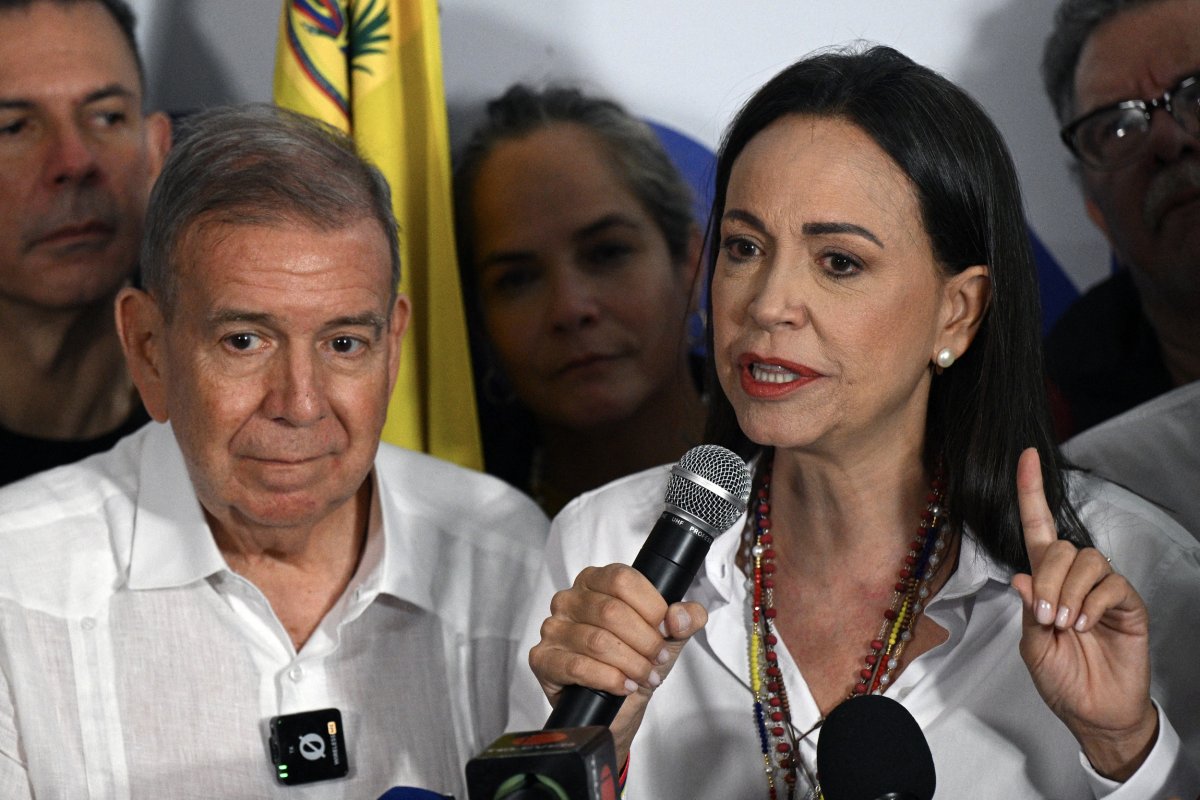
On Monday night, Machado disputed Maduro’s victory, saying that Gonzáles had won 70 percent of the vote—a result supported by multiple independent exit polls and quick counts. “Venezuela has a new president-elect and it is Edmundo Gonzáles. We won and the whole world knows it,” she said in a joint statement with Gonzáles.
“The Venezuelans and the entire world know what happened,” González said on Monday.
The CNE is supposed to be an independent authority but its head, Elvis Amoroso, is a close ally of Maduro, and the opposition says it works in his favor.
There are, as Machado said, several exit polls that predicted Gonzáles’ victory. An exit poll from Edison Research gave Gonzáles as the winner with 65 percent of the vote over Maduro’s 31 percent, as reported by Reuters. Local polling company Meganalisis predicted similar results, giving Gonzáles 65 percent of the vote and Maduro just under 14 percent.
FEDERICO PARRA/AFP via Getty Images
According to the opposition and reporters on the ground, the election was tainted by several irregularities. These included the moving of polling stations without informing voters, as reported by The New York Times, the removal of opposition witnesses at polling stations and officials’ refusal to hand over printouts verifying the electronic vote count.
While voting in Venezuela is electronic—meaning that citizens punch in a button assigned to their preferred candidate on a voting machine—there are two vote counts. One is the digital one received by the CNE, and the other one is a paper count printed by each voting machine at polling stations—which opposition witnesses were there to check.
U.S. Secretary of State Antony Blinken commented on Maduro’s announced victory, expressing skepticism over the autocrat’s victory. “We have serious concerns that the results announced do not reflect the will or the votes of the Venezuelan people… the international community is watching this very closely and will respond accordingly,” he said.
#BREAKING: Secretary of State Antony Blinken on Maduro announced election victory:
“We have serious concerns that the results announced does not reflect the will or the votes of the Venezuelan people… the international community is watching this very closely and will respond… pic.twitter.com/mhniy80mFM
— Moshe Schwartz (@YWNReporter) July 29, 2024
This is something of a rerun of 2018, when Maduro’s victory was labeled fraudulent by the U.S.
Chile’s President Gabriel Boric expressed similar concerns, saying he found Maduro’s victory “hard to believe.” Uruguay’s President Luis Alberto Lacalle Pou said that Maduro and his party “were going to ‘win’ regardless of the actual results.”
While the results of the election are disputed by the opposition, it’s unclear what will happen in the coming days. Gonzáles said he was not going to call for his supporters to take to the streets in protest or commit any act of violence.
What’s more likely to happen is a kind of bureaucratic showdown: Gonzáles has asked electoral authorities to present all the voting tallies printed by voting machines at the 30,000 polling stations across the country. The NCE is yet to provide the tallies.
Maduro has run the country for 11 years during which Venezuela has plunged into a deep economic collapse that has triggered a mass exodus, with about a third of the country’s population estimated to have left since his ascent to power. Between Maduro and his predecessor Hugo Chávez, the socialist PSUV party has been in power for the past 25 years.
Uncommon Knowledge
Newsweek is committed to challenging conventional wisdom and finding connections in the search for common ground.
Newsweek is committed to challenging conventional wisdom and finding connections in the search for common ground.
[ad_2]
Source link