

[ad_1]
Iowa lawmakers on Monday advanced a bill that would strip civil rights protections for transgender people, making Iowa the first state to rescind such a safeguard from its civil rights code.
Newsweek has reached out to state House Republicans and Senate Democrats via email for comment.
Why It Matters
Since beginning his second term, President Donald Trump has taken steps to unravel protections for transgender people as their rights have been under scrutiny since his 2024 campaign.
On Inauguration Day, Trump signed an executive order titled “Defending Women From Gender Ideology Extremism And Restoring Biological Truth To The Federal Government.” The order mandated that his administration would use “clear and accurate language and policies that recognize women are biologically female, and men are biologically male.” The federal government will also use the word “sex” instead of “gender” with all official documents, including passports, visas and Global Entry cards, “accurately reflecting the holder’s sex.”
Trump’s efforts come as transgender Americans have been the target of hundreds of Republican-backed bills in recent years including bathroom usage, sports participation by transgender athletes and restricting certain content in schools or libraries that refer to transgender identities.
What To Know
On Monday, the Iowa House subcommittee advanced House File 583, a measure that would strip the state civil rights code of protections based on gender identity, with a 2-1 vote, backed by Republican Representatives Steven Holt of Denison and Samantha Fett of Carlisle. Democratic Representative Ross Wilburn of Ames opposed the measure.
Later that day, the full House Judiciary Committee approved the bill 13-8. Representative Brian Lohse, a Republican from Bondurant, broke party ranks to join Democrats in voting against the legislation.
Iowa’s civil rights law protects against discrimination in employment, wages, public accommodations, housing, education and credit practices based on a person’s race, color, creed, gender identity, sex, sexual orientation, religion, national origin or disability status.
While the law has been in place since 1965, protections for sexual orientation and gender identity were not part of the original statute. They were added in 2007 when Democrats controlled the Legislature and governor’s office, with bipartisan support from roughly a dozen Republicans across both chambers.
A map created by Newsweek shows the 23 states and Washington, D.C., that prohibit discrimination based on sexual orientation and gender identity, according to the Human Rights Campaign.
While some states lack explicit protections against gender identity discrimination, courts in those states have interpreted existing laws to cover it. But the Iowa Supreme Court has previously rejected the argument that discrimination based on sex included discrimination based on gender identity.
If the bill is signed into law, Iowa would become the first U.S. state to roll back protections for a recognized class under its civil rights statutes—a move that civil rights groups say could set a dangerous precedent.
The bill now heads to a public hearing scheduled for Thursday morning, setting the stage for a potential floor vote that same day. With Republicans holding a 66-33 House majority, swift passage could be likely.
Senate Republicans introduced their own bill, Senate File 418, on Monday afternoon, indicating both chambers may seek to pass the legislation quickly. The Senate subcommittee was set to consider the proposal Tuesday afternoon.
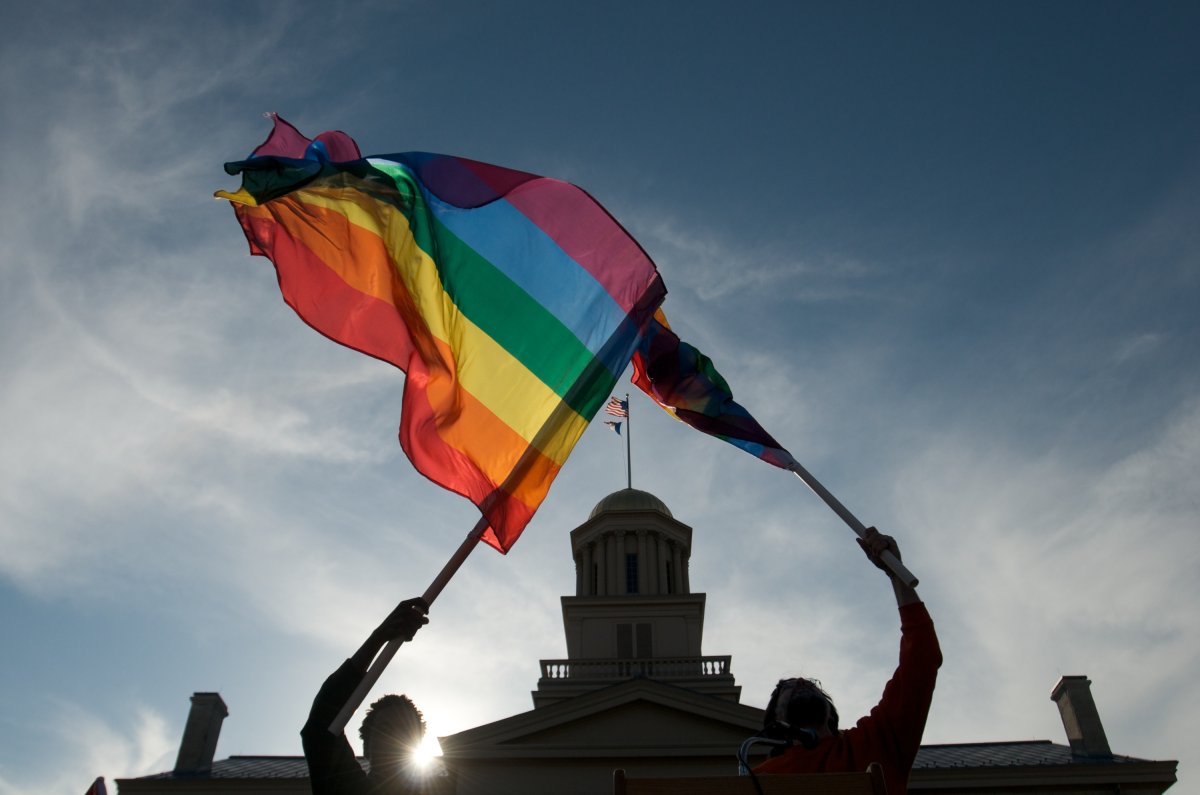
David Greedy/Getty Images
But the bill has faced backlash as Democrats, joined by LGBTQ+ advocates, warned of the measure’s implications with protests on Monday.
State troopers arrested two protesters after demonstrators filled the state Capitol’s hallways, chanting slogans like “we’re here, we’re queer, we will not disappear.”
The arrests came after complaints from lawmakers, who said they were struggling to hear testimonies, and officers using a megaphone to disperse the crowd into the rotunda. As the Judiciary Committee concluded its vote, protesters outside the chamber erupted with chants of “F*** you, fascists!”
Holt, the bill’s lead sponsor, defended the legislation. “It is time to stand up for truth,” he said during the subcommittee hearing. “We define male as someone who produces sperm, and female as someone who has ova—because that is true.”
What People Are Saying
Mandi Remington, county supervisor and activist in eastern Johnson County, per the Associated Press (AP): “It tells an entire group of Iowans — our neighbors, students, coworkers and family members — that they’re not worthy of the same rights and protections as everyone else.”
Amber Williams, lobbyist for Inspired Life, which advocates for Christ-centered culture, per AP: “The bill provides clarity in law, ensuring that sex-based protections cannot be overridden by fluid or subjective definitions of gender.”
Representative Austin Harris, a Republican of Moulton, wrote on X, formerly Twitter, last week: “I will oppose stripping Iowans of their civil rights protections with every fiber of my being.”
Iowa City Mayor Bruce Teague told the Des Moines Register he didn’t anticipate legislation like this to come down in the Iowa Legislature, so he drove the two hours to Des Moines to protest.
“It’s a moment in time, and there’s a lot of anger, a lot of grief behind it,” said Teague, who is gay. “But I also believe that there’s a lot of hope within our community and within our people of Iowa.”
What Happens Next
The bill will next move to the House floor for a vote but will also need to advance through the state Senate before Republican Governor Kim Reynolds could sign it into law.
[ad_2]
Source link