

[ad_1]
The famous groundhog Punxsutawney Phil saw his shadow early Sunday morning, predicting that Americans must endure six more weeks of winter before spring arrives. However, the groundhog’s predictions are rarely accurate.
Why It Matters
Each year, thousands of people watch online or in Punxsutawney, Pennsylvania, as the groundhog pops out of its den and gives its weather forecast for the coming weeks.
The groundhog saw his shadow this year, which is bad news for those looking forward to an early spring.
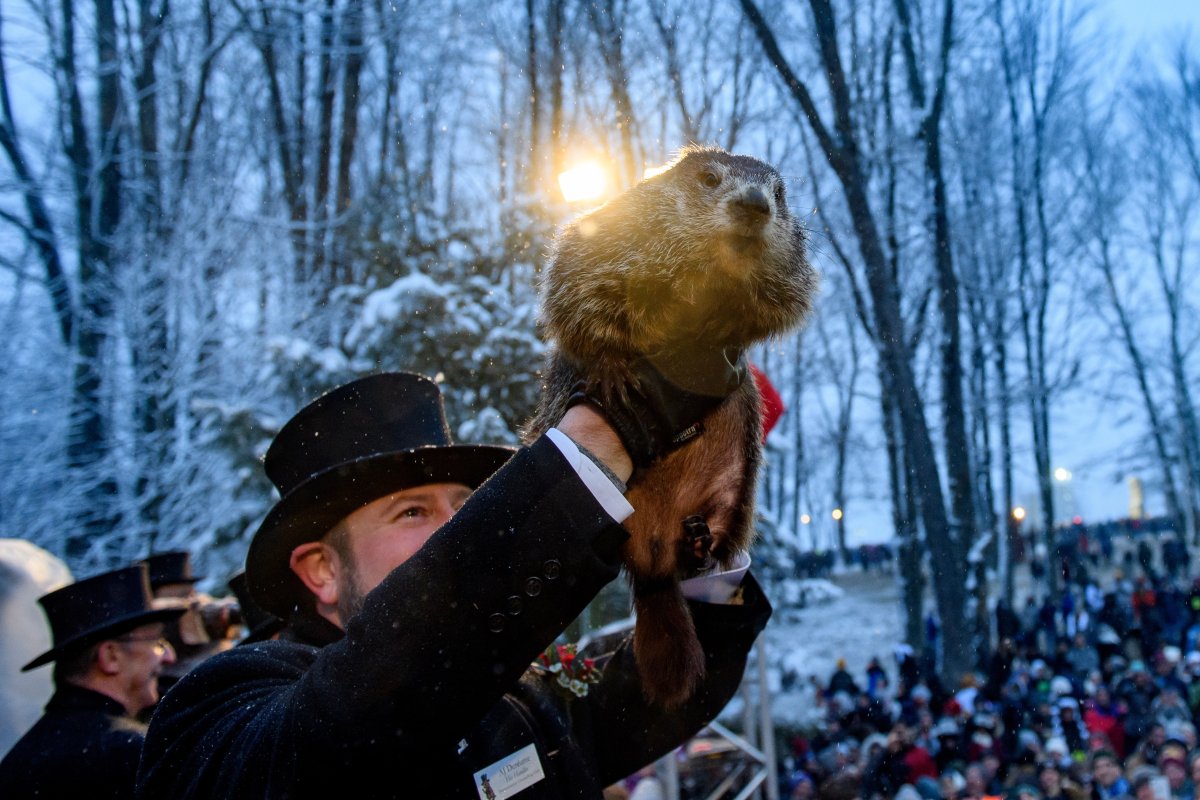
Jeff Swensen/Getty
What To Know
The Groundhog Day tradition claims that a famous groundhog living in Punxsutawney, Pennsylvania, can predict the weather based on whether or not it sees its shadow on February 2, the midway point between the winter solstice and the spring equinox.
If the groundhog sees its shadow, it runs back into its den, meaning there are six more weeks of winter. However, if the groundhog doesn’t see its shadow, it signifies that spring weather is around the corner.
Why Was Groundhog Day Established?
The first statewide celebration of Groundhog Day, which takes place on February 2 each year, occurred in 1887.
The tradition dates back to Candlemas Day, an early European Christian holiday that marked the halfway point between the winter solstice and the spring equinox. During the celebrations, if the weather was bright and clear, the remaining winter season would be arduous. They believed spring was right around the corner if it was a dully, cloudy day.
Germans embraced the tradition and added a hedgehog to the mix. The animal and its shadow would be the ones to predict how the rest of the winter season would go.
When Germans settled in America, they opted for a groundhog instead of a hedgehog.
How Accurate Are Punxsutawney Phil’s Season Predictions?
In recent years, Punxsutawney Phil’s predictions have been wrong 70 percent of the time, a National Oceanic and Atmospheric Administration (NOAA) spokesperson told Newsweek.
According to a NOAA webpage dedicated to the subject, Punxsutawney Phil’s predictions have only been right 30 percent over the past 10 years. Phil’s accurate predictions occurred in 2016, 2020 and 2024 in that timeframe. He didn’t see his shadow each time, predicting an early spring.
Could Climate Change Influence The Groundhog Predictions?
Phil’s track record isn’t very good, and as the weather changes with the increasing impacts of climate change, his accuracy could get even worse.
However, some data shows that if the groundhog were to predict an early spring, he might be right more regularly because climate change shortens winters.
What People Are Saying
NOAA’s National Centers for Environmental Information, on its website: “In 2024, Phil forecast an ‘early spring’ when he didn’t see his shadow and predicted six weeks of spring temperatures. In fact, the contiguous United States saw above average temperatures in February and above average temperatures in March of last year. Phil was spot on in his forecast.”
What Happens Next
Based on meteorological forecasts, the northwestern half of the country is expecting an abnormally cold start to February, particularly in the Pacific Northwest, the National Weather Service (NWS) Climate Prediction Center’s 8- to 14-day temperature outlook shows.
However, when looking further out, the three- to four-week temperature outlook shows above-average temperatures for most of the U.S.
[ad_2]
Source link